
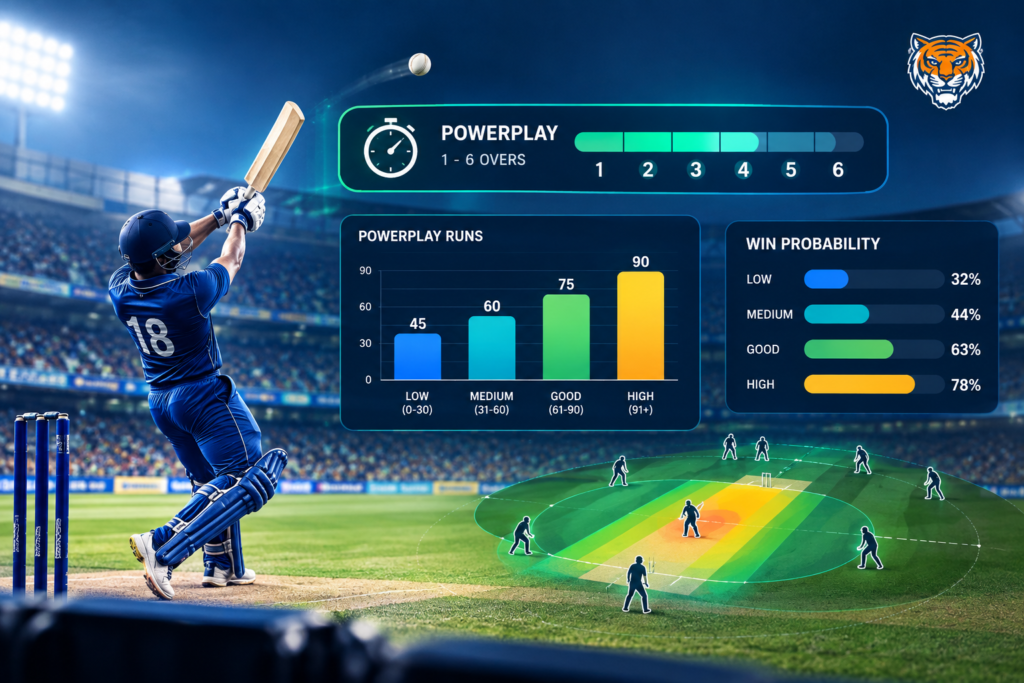
In T20 cricket, the first six overs can provide an early indication of how a match is developing, but powerplay scoring alone does not determine the eventual winner. A strong start can improve a team’s position by building runs while fielding restrictions are in place, whereas early wickets can offset a high scoring rate. For anyone following a cricket exchange, the useful question is therefore not simply how many runs were scored, but what those runs mean alongside wickets, pitch conditions, batting depth and the remaining overs.
The powerplay creates a distinctive tactical phase because fielding restrictions limit the number of players who can be positioned outside the designated fielding circle. Under current ICC Men’s T20I playing conditions, the first six overs are subject to these restrictions, with no more than two fielders allowed outside the fielding restriction area at the instant of delivery.
That combination of field placement, attacking batting and limited overs makes the opening phase particularly important when assessing the state of a T20 match.
Why the First Six Overs Matter So Much
The powerplay gives batting teams an opportunity to score boundaries while the fielding side has fewer options for protecting the boundary.
This does not mean batters should attack every delivery. Teams still have to balance scoring opportunities against the risk of losing wickets. A side that reaches 60 runs without losing a wicket has created a different platform from one that scores 70 but loses four wickets.
The distinction matters because wickets affect the resources available for the rest of the innings. A team with established batters at the crease can potentially accelerate later, while a side that has already lost several important wickets may need to rebuild.
This is why powerplay runs should always be considered together with wickets.
Run Rate Gives the Score More Context
A raw score after six overs can be misleading without considering the scoring rate.
For example, 48 runs from six overs represents an average of 8 runs per over. A score of 60 represents 10 runs per over. On the surface, the second innings appears to have started more aggressively.
But the comparison becomes more complicated if the first team lost three wickets while reaching 60 and the second lost none while reaching 48.
The lower-scoring side may have preserved more batting resources for the middle and final overs. Meanwhile, the higher-scoring side may have created immediate scoreboard pressure but reduced its ability to accelerate later.
This is why match probability models and human analysis need more than one number. The score, wickets, required rate and remaining resources should be viewed together.
Powerplay Runs and the Changing Match Picture
A strong powerplay can influence the match in several ways.
First, it can increase the projected total if the batting side maintains a similar scoring rate. Second, it can put pressure on the opposition by creating a higher target than initially expected. Third, it can allow middle-order batters to play with greater flexibility because the team has already established a solid scoring base.
However, the effect is not permanent.
A team can score heavily during the first six overs and then slow down because of spin, changing pitch conditions, accurate death bowling or the loss of key batters. Likewise, a cautious powerplay can be followed by a significant acceleration later.
Historical match analysis therefore needs to avoid treating the powerplay as a standalone predictor.
Wickets Can Matter More Than a Few Extra Runs
Consider two fictional teams after six overs.
Team A: 55/0
Team B: 64/3
Team B has scored nine more runs, but Team A has all ten wickets available.
There is no universal rule saying Team A is automatically in the stronger position. The value of those wickets depends on the players involved, pitch conditions, match format and expected scoring environment.
Still, the example demonstrates why runs cannot be separated from wickets.
A T20 innings is a limited resource. Once key batters are dismissed, a team may have fewer options for sustaining an aggressive scoring rate. On the other hand, a team with wickets in hand can potentially increase its scoring during the later stages.
The first six overs therefore establish a platform rather than a final conclusion.
How Powerplay Performance Can Influence Match Probability
Match probability changes because the state of the game changes.
Suppose a team batting first scores 62 without losing a wicket. If the venue normally produces competitive totals and the batting lineup contains several strong finishers, that opening phase may support expectations of further scoring.
Now imagine the same team reaches 62 but loses three wickets. The projected total may need to be reassessed because the remaining batting resources are different.
The same principle applies during a chase. A chasing side that reaches 58/1 after six overs may have a different outlook from one at 58/4, even though the scores are identical.
Required run rate becomes particularly important at this point. If the target is 175, a chasing team on 58 after six overs needs 117 from the remaining 14 overs. That works out to 8.36 runs per over.
The calculation is straightforward, but its interpretation requires context. Eight or nine runs per over may be manageable at one ground and much more demanding at another.
The Role of Fielding Restrictions
The powerplay is not simply a period when teams try to score quickly. The fielding restrictions shape how captains and batters approach those overs.
With fewer fielders allowed outside the circle, gaps at the boundary can create scoring opportunities. Batters may use aerial shots or aggressive stroke play to exploit those spaces.
At the same time, bowlers can respond with different lengths, changes of pace and attacking fields within the permitted restrictions.
The ICC’s current T20I playing conditions specify that the first six overs carry these additional fielding restrictions. The restrictions are also adjusted when an innings is shortened, meaning a reduced-overs match does not necessarily follow the standard six-over structure.
That distinction matters when comparing powerplay performances across different matches.
Venue and Pitch Conditions Can Change the Meaning of a Good Start
The same powerplay score can represent very different performances depending on the venue.
If the pitch is flat and the boundary dimensions are short, a high scoring rate may be expected. On a slower surface where timing the ball is difficult, the same score may represent a stronger batting effort.
Weather can also influence the interpretation. Dew during a night match may affect grip for bowlers later in the innings, while wind direction can influence shot selection and boundary scoring.
This is why a useful match analysis should avoid universal statements such as “60 runs in the powerplay guarantees a strong total.” It does not.
The conditions surrounding the score matter just as much as the score itself.
Cricket Exchange Markets After the Powerplay
Once six overs are completed, market participants have more information than they had before the match began.
They can now assess the actual scoring rate, wickets lost, individual batter performance, bowling effectiveness and pitch behaviour.
That new information can lead to changes in available prices and market expectations. However, a movement does not mean that an outcome has become certain.
A team can dominate the opening six overs and still lose because of a middle-order collapse, an exceptional bowling spell or a successful chase. Conversely, a slow beginning can be recovered through acceleration later in the innings.
The powerplay is therefore best treated as one piece of evidence within the wider match picture.
Reading Cricket Exchange Probability After Six Overs
A practical approach is to examine several factors together rather than focusing exclusively on the score.
Start with the runs and wickets. Then calculate the current scoring rate and compare it with the expected scoring environment. For a chase, check the target and required run rate. After that, consider the quality of batters remaining, the bowlers available and the conditions at the venue.
For example, 52/1 after six overs may look ordinary in isolation. But if the target is 185 and the pitch is producing easy boundaries, the situation may be very different from 52/1 on a difficult surface where the average scoring rate is much lower.
This type of contextual analysis provides a more realistic picture than treating the powerplay score as a prediction by itself.
Powerplay Success Does Not Guarantee a Winning Result
One of the easiest mistakes in T20 analysis is giving too much importance to the first six overs.
The powerplay can create momentum, but momentum can disappear quickly. A batting side may lose consecutive wickets in the seventh and eighth overs. A bowling side may introduce a spinner who controls the middle overs. A set batter may be dismissed immediately before the death overs.
Likewise, a team that starts slowly can recover through partnerships and late acceleration.
The match remains dynamic throughout all 20 overs.
Powerplay statistics are most useful when they help explain why the match has moved into a particular state, rather than when they are treated as proof of what will happen next.
A Simple Example of Powerplay Match Analysis
Imagine Team A scores 57/1 in the first six overs while chasing 168.
It now requires 111 runs from 14 overs, meaning a required rate of approximately 7.93 runs per over.
That figure provides useful context, but it is not enough to determine the team’s position.
If the two batters at the crease are established players and the pitch is good for stroke play, the chase may remain well positioned. If the surface is slowing down and the batting side has limited depth, the same mathematical requirement could become more difficult.
Now compare that with a team at 57/4 after six overs. The target and required rate are identical, but the remaining resources are not.
This simple example shows why match probability should account for both numerical requirements and the cricket situation behind them.
What to Watch After the Powerplay
The end of the powerplay marks the beginning of a different tactical phase.
The fielding restrictions change, allowing captains to protect boundaries more effectively. Bowlers can use different defensive fields, and batting teams may shift from boundary hunting to strike rotation before launching another attack later.
For analysts, the next few overs can reveal whether the powerplay was genuinely valuable or simply an aggressive burst that could not be sustained.
Partnerships become increasingly important, while the availability of specialist bowlers for the final overs can influence the expected scoring pattern.
Looking at the transition from powerplay to middle overs can therefore provide more insight than examining the opening score alone.
Conclusion
Powerplay scoring matters in T20 cricket because the first six overs combine fielding restrictions, aggressive scoring opportunities and limited time. A strong start can establish a useful platform, but its impact depends heavily on wickets, pitch conditions, remaining batting resources and the scoring requirements of the match.
For live analysis, the most useful approach is to connect the powerplay score with the wider state of play. Runs without wickets tell only part of the story. Required run rate, batting depth, bowling resources and venue conditions can all change the meaning of an apparently strong or weak start.
Ultimately, the powerplay is an important checkpoint not a final verdict on the match.
Frequently Asked Questions
What is the powerplay in T20 cricket?
The powerplay normally covers the first six overs of a T20 innings, during which specific fielding restrictions apply. Under current ICC Men’s T20I conditions, no more than two fielders can be outside the designated fielding restriction area at the instant of delivery during these overs.
Why are powerplay runs important in T20 cricket?
They can help establish the scoring platform for an innings, particularly because fielding restrictions can create additional boundary-scoring opportunities.
Do powerplay runs predict the winner?
Not by themselves. Wickets, pitch conditions, batting depth, bowling resources and the required run rate can all change the eventual outcome.
Is 60 runs a good powerplay score?
There is no universal benchmark. Whether 60 is strong depends on the venue, pitch, wickets lost, opposition bowling and expected scoring conditions.
How do wickets affect the value of powerplay scoring?
Wickets represent lost batting resources. A high score with several wickets lost can have a different implication from a slightly lower score achieved without losing wickets.
Can a team recover from a poor powerplay?
Yes. T20 innings can change quickly, and teams can accelerate during the middle or death overs through partnerships, favorable matchups and aggressive batting.
Does the powerplay affect live match probability?
It can contribute to changes in probability because it provides new information about scoring rate, wickets, player performance and pitch conditions. It should still be considered alongside the rest of the match situation.
What should be considered after the first six overs?
The score, wickets, required run rate, batting resources, remaining bowlers, pitch conditions and expected scoring environment all provide useful context for evaluating the match.